



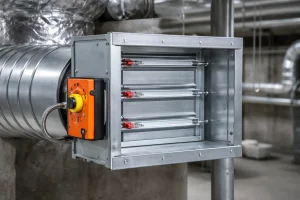
Mechanical Fall-Safe Fire Dampers in HVAC Passive Fire Protection
Modern structural safety relies heavily on the concept of compartmentation dividing a building into distinct, sealed thermal zones to confine fire, heat, and toxic gases to their point of origin. While concrete walls and fire-rated doors form solid physical boundaries, commercial buildings require a vast network of Heating, Ventilation, and Air Conditioning (HVAC) ductwork to maintain air circulation. These air ducts must breach fire-rated barriers, creating a dangerous vulnerability: open channels that can act as chimneys, rapidly transporting lethal smoke and superheated air across multiple floors. To neutralize this structural weakness, safety engineers rely on a critical class of Passive Fire Protection (PFP) hardware known as mechanical fall-safe fire dampers.
The Physics of Autonomous Activation
Unlike active fire protection systems, which depend on electronic smoke detectors, digital building management networks, or backup generators, mechanical fire dampers operate completely autonomously. They are purely mechanical, relying on basic laws of physics, material thermodynamics, and gravity to perform their safety function.
The core trigger mechanism of a standard damper is the thermal fusible link. This link is a two-piece metallic component held together by a highly specialized, low-melting-point eutectic alloy. This alloy is precisely engineered to maintain its structural solid state under normal building operating temperatures. However, when ambient heat inside the HVAC duct reaches a critical safety threshold typically 74°C (165°F) for comfort ventilation systems the alloy instantly undergoes a phase change and melts.
Once the eutectic alloy liquefies, the two halves of the fusible link separate under the tension of the damper mechanism. This separation breaks the physical restraint holding back the damper blades, initiating the mechanical closure sequence without requiring a single watt of electrical power.
Mechanical Architecture: Curtain vs. Multi-Blade Dampers
Fire dampers are generally manufactured using heavy-gauge galvanized steel or stainless steel to withstand extreme thermal exposure without warping or melting. Architecturally, they are classified into two primary mechanical designs:
- Curtain Fire Dampers: This configuration features a series of interlocking, folded steel blades stacked tightly at the top of the duct sleeve, completely out of the normal airflow path. When the fusible link separates, gravity or an integrated constant-force stainless steel spring pulls the folded steel curtain downward. The blades unroll rapidly, interlocking with each other to form a solid, continuous metallic wall that completely seals the duct opening.
- Multi-Blade (Louvre) Fire Dampers: This design utilizes a series of parallel or opposed aerodynamic steel blades that rotate on central pivots. In their normal state, the blades sit parallel to the airflow to minimize static pressure and resistance. Upon activation, an internal spring-loaded linkage system rotates the blades 90 degrees simultaneously, snapping them shut against perimeter steel stops to cut off the duct passage.
Dynamic vs. Static Operational Environments
To select and deploy dampers correctly, system designers must evaluate the aerodynamic state of the HVAC system during a fire emergency. Dampers are categorized by their ability to close against moving air:
- Static Fire Dampers: These units are certified for use exclusively in HVAC systems that are configured to shut down automatically the moment a fire alarm is triggered. Because the fans turn off, there is no significant airflow velocity or static pressure inside the duct when the damper activates. The steel blades simply fall or snap into place without resisting kinetic air currents.
- Dynamic Fire Dampers: In many modern high-rise buildings, HVAC fans are engineered to stay on during an emergency to assist in pressurized smoke control and extraction. Dynamic fire dampers are heavily reinforced to slam shut against intense, high-velocity moving airstreams. They utilize high-tension closure springs to overcome the dynamic pressure of the air, ensuring a secure seal even when fans are operating at peak capacity.
Testing Standards and Regulatory Compliance
Because fire dampers are hidden deep within mechanical spaces, they must adhere to rigorous manufacturing and testing standards before deployment. Industrial protocols subject dampers to extreme testing conditions, including a fire endurance test where the assembly must withstand rapid temperature rises matching the standard time-temperature curve for up to three or four hours. Immediately following the thermal test, the glowing-hot damper is blasted with a high-pressure water hose stream to verify its structural integrity against thermal shock and impact.
Furthermore, regular maintenance is legally mandated by regional life safety codes. Facility managers must physically test the functionality of every damper on a strict schedule—typically one year after installation and every four years thereafter in commercial structures—ensuring the fusible links are free of debris and the mechanical springs remain fully operational. By securing these hidden open pathways, dampers ensure that spatial compartmentation remains unbreakable during a crisis.