Trending
Directory
Time :




The ASTM E84 and UL 723 are test methods commonly used in the construction industry to evaluate the surface burning behaviour of construction materials.
The need to understand the properties of fire has been part of human experience since early civilization. Discovery of scientific concepts such as the First Law of Thermodynamics in the 19th century brought about development of calorimetry tools used to measure temperatures and heat flux. In the 20th century, a revolution in measuring and understanding fire began, and a need arose for the creation of fire standards to protect life and property.
Incidents such as the Cocoanut Grove Nightclub fire in 1942, the La Salle Street Hotel and Winecoff Hotel fires in 1946 highlighted the influence of interior finishes and decorations on the flame spread within a building.
As a result of these fires, Albert J. Steiner (of Underwriters Laboratories) took on the responsibility to develop a test method for measuring the fire performance of surface finishes and flooring materials. He developed a large-scale tunnel furnace known as the “Steiner Tunnel’’ named by UL in his honour.
The tunnel, first built in the 1920s, required refurbishments in the 1940s due to the push for less flammable wood-based products, and the adoption of new and composite building materials. Following these upgrades, the UL 723 was published by Underwriters Laboratories in 1950, followed by an adoption by the American Society for Testing Materials (ASTM) in 1961 as the ASTM E84.
With both methods, the test material is mounted in the ceiling position with the surface to be evaluated exposed face down to the ignition source. A gas burner producing heat of approximately 88 kW is located on one end of the tunnel, the “fire side”.
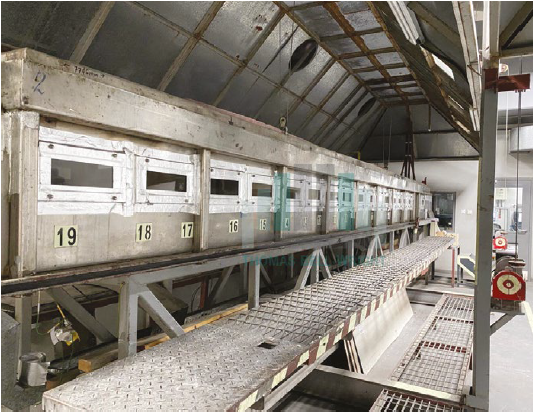
One side of the tunnel is fitted with observation windows that allow for the propagation of the flame away from the ignition source across the surface of the specimen to be monitored. A photometer system is also fitted at the vent end of the tunnel. The output of the photocell is proportional to the amount of smoke and particles produced during a test.
After the 10 minutes test duration, the recorded flame spread and smoke development data is used to calculate the Flame Spread Index (FSI) and Smoke Development Index (SDI), respectively.
Although the ASTM E84 and the UL 723 provide test procedures for determining the FSI and SDI values for a given material, they do not provide classification criteria.
Authorities Having Jurisdiction (AHJs) use results from these tests to determine if a material meets the building code requirements for specific applications. The International Building Code (IBC) classifies tested materials under either Class A, B, or C, as follows:
| Class A | Flame spread index 0 – 25; smoke-developed index 0 – 450 |
| Class B | Flame spread index 26 – 75; smoke-developed index 0 – 450 |
| Class C | Flame spread index 76 – 200; smoke-developed index 0 – 450 |
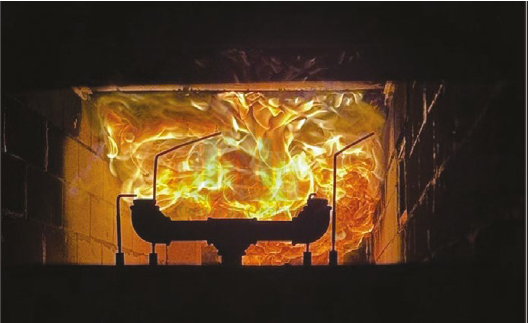
Different materials exhibit varying fire performance under UL 723/ASTM E84 testing. Parameters such as the composition, thickness, moisture content, and surface finish affect how rapidly the material ignites, how much it propagates flames, and how much smoke it produces.
Test results obtained from specimens tested at a lower thickness may vary from those at a higher thickness. For instance, with intumescent coatings, the Dry Film Thickness (DFT) is a critical design parameter. A lower DFT means that the char layer formed may not be adequate to protect the substrate, while a thicker DFT may result to a thicker char layer that could crack and delaminate during the test resulting to a failure.
Many materials used as interior finishes such as wood or wood-based products are hygroscopic in nature, and their moisture content at the time of testing can affect their flame spread characteristics. Both the ASTM E84 and the UL 723 require that the test materials are conditioned to a constant mass under specified conditions of temperature (73.4 °F ± 5 °F) and relative humidity (50 % ± 5 %).
The mounting method of a specimen during the test also influences the performance of a material. For example, when adhesives are used to adhere specimens such as textiles to a substrate and a V-notched trowel is used, the adhesive may be forced into and through the specimen. The resulting FSI and SDI values would not necessarily relate to the corresponding indices obtained from testing without this influence.
The use of supports is limited to materials that are not self supporting, as their use on the exposed face may interfere with the progress of the flame front. It is therefore necessary to provide minimal amount of support to a specimen to achieve meaningful assessment of its surface burning properties.
It is often assumed that the FSI value is directly proportional to the SDI value, but this is not the case; a product such as Fibre Reinforced Plastic (FRP) may have a low FSI value but high SDI value, while a foil faced glass wool insulation may have a high FSI value but low SDI value.
These two test methods have several limitations, including the orientation of the specimen. Because the specimen is evaluated in a horizontal ceiling position, question arises as to how results obtained from this setup relate to vertically oriented materials in their end-use applications.
For composite panels with metal facings and combustible cores, the surface burning characteristics of the core may not be fully assessed as the metal facings remain impermeable to flame spread throughout the test.
Testing thermoplastics materials that melt and drip to the tunnel floor and continue burning presents a challenge in evaluating their flame spread. These materials usually receive a low FSI value because they fall to the tunnel floor. If tested while supported on rods or nettings, they can be completely engulfed in flames, which makes the comparison between the FSI and SDI values of these materials and those of unsupported materials questionable. The UL 723 provides a method to distinguish between the flame spread and smoke developed values associated with burning in the ceiling position and those associated with burning on the tunnel floor.
In summary, although the ASTM E84 and UL 723 provide methods of determining the FSI and SDI values of a material, the two indices do not necessarily share a relationship. Results obtained from a specimen tested with supports may not relate to indices obtained by testing materials without the supports. Testing of materials that melt and drip to the tunnel floor thus affecting advancement of the flame front results in low FSI values that do not relate directly to indices obtained by testing materials that remain in place.
With a very different concept, the magazine received tremendous and positive response. Passive Fire Safe India is the first magazine covering the Passive Fire segment. Passive fire protection involves Read More..
© Passive Fire Safe India. 2026 All Rights Reserved. Designed by VMH Web Solutions