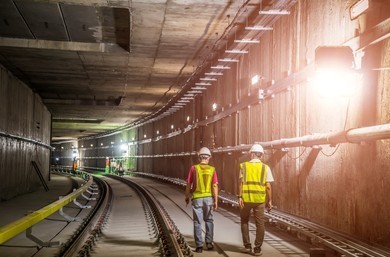
Passive Fire Protection for Metro Rail and Underground Infrastructure
Highlight
Passive fire protection is essential for metro rail and underground infrastructure, where confined spaces, limited evacuation routes, and extreme fire conditions create major safety challenges. Fire compartmentation, tunnel linings, firestop systems, and structural fireproofing help control smoke spread, protect critical infrastructure, preserve structural integrity, and support safe evacuation during emergencies.
As urban populations continue to grow, cities across the world are rapidly expanding their underground transportation networks to improve mobility and reduce congestion. In India, metro rail systems have become a critical part of urban infrastructure development, with major projects operating or under construction in cities such as Delhi, Mumbai, Bengaluru, Hyderabad, Chennai, Pune, Ahmedabad, and Nagpur. Alongside metro rail expansion, underground infrastructure including tunnels, basements, transport hubs, utility corridors, and underground stations is becoming increasingly common in modern urban planning.
While underground infrastructure offers major operational and environmental benefits, it also presents unique and highly complex fire safety challenges. Confined spaces, limited evacuation routes, high occupant density, restricted ventilation, and difficult emergency access make fires in underground environments significantly more dangerous than fires in open buildings. In such scenarios, passive fire protection becomes one of the most critical components of the overall life safety strategy.
Passive fire protection in metro rail and underground infrastructure is designed to contain fire, limit smoke spread, preserve structural stability, and maintain safe evacuation conditions during emergencies. Unlike active systems such as sprinklers or suppression equipment, passive systems work continuously without activation, forming the structural backbone of underground fire safety.
Controlling Smoke Through Effective Compartmentation
One of the biggest risks in underground fires is smoke movement. In enclosed tunnels and underground stations, smoke can accumulate rapidly due to restricted natural ventilation. Toxic smoke and heat can travel through tunnels, shafts, ventilation systems, and interconnected spaces, reducing visibility and making evacuation extremely difficult. In many fire incidents, smoke inhalation poses a greater threat to occupants than direct flame exposure.
Passive fire compartmentation therefore plays a critical role in controlling smoke migration within underground infrastructure. Fire-rated walls, floors, tunnel linings, service enclosures, cable tunnels, smoke barriers, and fire doors help divide underground spaces into protected zones, limiting the spread of smoke and fire between compartments.
Metro stations, in particular, contain numerous high-risk areas including electrical rooms, control centers, communication systems, retail spaces, escalator zones, HVAC systems, and equipment rooms. Proper compartmentation ensures that fires originating in one area do not rapidly spread throughout the station or tunnel network.
Protecting Tunnels Against Extreme Fire Conditions
Tunnels present another major challenge for passive fire engineering. Tunnel fires can generate extremely high temperatures, particularly when trains, vehicles, fuel systems, or electrical equipment are involved. In some scenarios, temperatures may exceed 1000°C within minutes. These extreme conditions can severely damage structural concrete, steel reinforcement, cable systems, and critical infrastructure components.
One of the most serious structural risks in tunnel fires is concrete spalling. Under rapid heat exposure, moisture trapped within concrete expands violently, causing layers of concrete to break away from the surface. This process exposes reinforcement bars to extreme temperatures, potentially compromising structural integrity and increasing collapse risks.
To address this challenge, specialized passive fire protection materials are widely used in tunnels and underground structures. Fire-resistant tunnel linings, cementitious sprays, fireproof boards, mineral wool systems, and protective coatings help insulate structural elements and reduce heat transfer during fires. These systems are specifically engineered to withstand hydrocarbon fire curves, which are far more severe than standard building fire conditions.
Hydrocarbon fires develop rapidly and produce significantly higher temperatures due to fuels, oils, plastics, and electrical systems commonly found in transport infrastructure. As a result, tunnel fire protection systems must meet much stricter performance requirements than those used in conventional buildings.
Cable and Service Penetration Protection
Cable protection is another essential aspect of underground passive fire safety. Metro systems rely heavily on electrical power, communication networks, signaling systems, and emergency control infrastructure. Cable trays and service penetrations can act as hidden pathways for fire and smoke spread if not properly protected.
Passive fire systems such as firestop sealants, cable coatings, fire-rated wraps, and penetration barriers are therefore critical for maintaining compartment integrity around cable installations. In many underground facilities, maintaining operational continuity of emergency systems during a fire is just as important as protecting structural elements.
Supporting Safe Evacuation
Evacuation safety is one of the most important objectives of passive fire protection in underground infrastructure. Unlike above-ground buildings, underground spaces often have fewer exit routes and more complicated evacuation conditions. Occupants may need to travel long distances through tunnels, smoke-controlled corridors, or emergency escape passages to reach safety.
Fire-resistant walls, protected escape routes, smoke barriers, and fire-rated doors help maintain survivable conditions during evacuation by slowing the spread of heat and smoke. Compartmentation also assists emergency responders by creating more controlled firefighting environments.
Ventilation systems play a major role in underground fire management, but they must work together with passive fire systems to be effective. Fire dampers, smoke barriers, and compartmentation walls help direct smoke movement and prevent uncontrolled smoke migration through ventilation shafts and ducts.
Addressing Modern Infrastructure Risks
Another growing concern in metro infrastructure is the increasing use of advanced technologies and electrification systems. Modern underground facilities contain extensive data networks, battery backup systems, communication equipment, automation controls, and high-voltage electrical infrastructure. These systems increase both the fire load and the complexity of fire compartmentation strategies.
The rise of lithium-ion battery technologies and energy storage systems in transportation infrastructure is also creating new fire protection challenges. Battery-related fires can generate intense heat, toxic gases, and rapid thermal runaway conditions that require highly specialized compartmentation and material performance strategies.
Material selection is therefore becoming increasingly important in underground passive fire protection. Non-combustible materials such as mineral wool, calcium silicate boards, cementitious coatings, and fire-rated concrete systems are widely preferred because they contribute minimal smoke and maintain structural stability under extreme heat conditions.
Testing, Certification and Maintenance
Testing and certification are essential in underground infrastructure projects due to the severe fire conditions involved. Passive fire systems used in tunnels and metro environments are evaluated under specialized standards including hydrocarbon fire curves, tunnel fire simulations, and high-temperature structural testing protocols. These tests assess insulation performance, structural stability, integrity, smoke resistance, and long-term durability under extreme conditions.
Maintenance and inspection also play a critical role in underground fire safety. Passive fire systems may deteriorate over time due to vibration, moisture, water ingress, corrosion, operational wear, or maintenance activities. Underground environments are particularly vulnerable to humidity and environmental stress, making regular inspection programs essential for long-term reliability.
Digital technologies such as Building Information Modeling (BIM), digital twins, and smart inspection platforms are increasingly being integrated into underground infrastructure management. These systems help track fire-rated assemblies, inspection records, maintenance history, and compartmentation status throughout the lifecycle of the facility.
The Road Ahead
In India, rapid metro expansion and urban infrastructure growth are increasing the need for advanced passive fire engineering expertise. As underground transportation networks become more interconnected and densely occupied, fire safety expectations are also becoming more stringent. Authorities, consultants, and infrastructure developers are placing greater emphasis on compartmentation, smoke control, certified materials, and long-term system reliability.
The future of passive fire protection in underground infrastructure will likely involve smarter materials, improved digital monitoring, enhanced evacuation modeling, and greater integration between active and passive systems. Sustainability and resilience will also become increasingly important as cities develop next-generation transportation networks.
Conclusion
Ultimately, underground infrastructure presents some of the most demanding fire safety conditions in the built environment. In these enclosed and high-risk spaces, passive fire protection serves as a critical line of defense that protects lives, infrastructure, and operational continuity during emergencies.
While often hidden behind tunnel linings, service walls, and equipment enclosures, passive fire systems quietly support the safety and resilience of modern transportation infrastructure every day. As cities continue to build beneath the surface, the importance of effective passive fire protection will only continue to grow.