



The Role of Passive Fire Safety in Smart Cities and Future Infrastructure
Highlight: Fire safety shouldn’t be a last-minute addition. Integrating passive fire protection at the blueprint stage ensures that materials, layouts, and systems work cohesively to contain fires, protect structures, and enable safe evacuation. This proactive design philosophy saves costs, simplifies compliance, and builds inherently safer, more resilient buildings.
The world is moving toward smarter, more connected cities where sensors regulate traffic, buildings monitor energy use, and citizens interact seamlessly with their environment. In India, the Smart Cities Mission has spurred rapid urban transformation, emphasizing digital connectivity, efficiency, and sustainability. But amid this innovation lies a crucial question: are these futuristic cities designed to be fire-safe? Active systems like alarms and sprinklers often dominate safety discussions, yet passive fire safety the backbone of building resilience remains equally vital for the success and sustainability of smart cities.
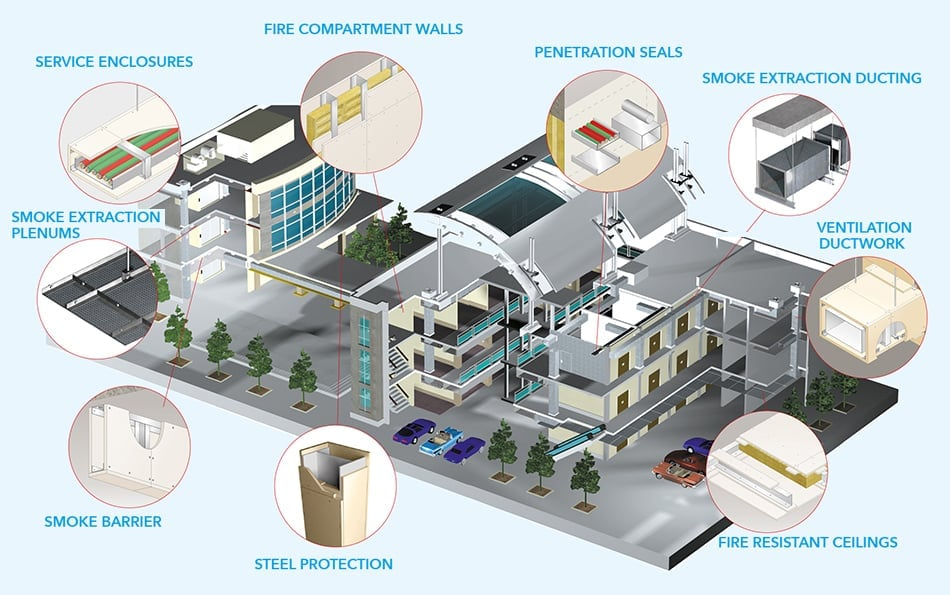
Passive Fire Protection (PFP) consists of built-in systems that contain fire, limit its spread, and preserve structural integrity, even when active systems fail. These include fire-rated walls, floors, doors, claddings, sealants, and coatings that slow down fire progression, protect critical infrastructure, and allow occupants to evacuate safely. As urban centers grow denser and high-rise buildings become more common, passive fire safety isn’t just a code requirement it’s an essential part of intelligent urban resilience.
In a smart city, where infrastructure is interconnected and data-driven, passive fire protection plays an expanded role. It is no longer viewed as static or isolated it becomes a design strategy that enhances sustainability, supports building automation, and safeguards essential services like power, transport, and communication. For example, fire-rated enclosures around electrical or data cabling in smart buildings prevent fire from crippling digital networks that control entire urban systems.
Designing Smart from the Start
The integration of passive fire protection must begin at the urban planning and design phase. In smart cities, buildings are designed as part of a network linked through transport hubs, skywalks, underground tunnels, and shared utilities. This connectivity increases fire risk due to potential pathways for heat and smoke transfer. Fire compartmentation dividing structures into independently fire-resistant zones ensures that a blaze in one section doesn’t cascade into adjacent buildings or transit corridors. Using fire-resistant walls, dampers, and glass partitions allows cities to achieve both connectivity and safety.
Architects and planners in smart cities must also consider mixed-use developments where residential, commercial, and recreational spaces coexist. Each use type presents distinct fire risks. Passive fire barriers, doors, and coatings help maintain safety continuity across these varying risk zones, ensuring that design flexibility does not come at the cost of fire integrity.
Intelligent Materials for Intelligent Cities
The evolution of materials science has made it possible to integrate smart passive fire systems that adapt to their environment. Advanced intumescent coatings, for instance, expand when exposed to heat, forming an insulating char that shields structural steel from collapsing. Some new formulations are even designed with sensor integration, capable of reporting temperature or coating integrity data to building management systems. These innovations turn traditionally “passive” components into data-aware systems that align with the smart city ethos of real-time monitoring.
Similarly, fire-rated glass and cladding systems have evolved to combine transparency and protection enabling architects to design open, energy efficient façades without compromising safety. High performance glass units can now withstand up to two hours of fire exposure while maintaining visibility and natural lighting key components of sustainable and intelligent urban architecture.
Sustainability and Fire Resilience
Smart cities are expected to be green, efficient, and low emission. However, sustainability and fire safety must coexist harmoniously. Many eco-friendly materials, such as composite panels or insulation derived from bio-based sources, may be more combustible than traditional materials. Therefore, incorporating fire-resistant linings, barriers, and sealants ensures that green construction doesn’t become a fire hazard.
Fire-safe materials also contribute to sustainability by extending building life spans and minimizing reconstruction waste after fire incidents. By choosing non-toxic, recyclable fireproofing compounds and low VOC coatings, smart cities can meet both environmental and safety objectives. The integration of passive fire protection within green building certification systems such as LEED, IGBC, or BREEAM is gaining recognition as part of holistic sustainability planning.
Digital Twins and Predictive Fire Modeling
One of the most transformative developments for smart city fire safety is the use of digital twin technology a virtual replica of a building or infrastructure that simulates performance in real-world scenarios. By embedding passive fire protection data into digital twins, engineers can model fire spread, smoke flow, and structural response before construction begins. This predictive capability allows designers to refine compartmentation, evacuation routes, and material choices early on.
When combined with Internet of Things (IoT) networks, digital twins can continuously monitor fire safety performance. For instance, sensors can track temperature changes near fire-rated doors, dampers, or coatings, providing alerts when maintenance or inspection is needed. This integration of digital oversight with passive systems creates a self-sustaining loop of safety management a true hallmark of a smart city.
Resilient Infrastructure Beyond Buildings
Passive fire safety extends far beyond individual structures. Smart cities depend on infrastructure—tunnels, subways, data centers, and utility corridors that must remain operational during and after fire incidents. These facilities require specialized passive protection systems such as fireproof cable trays, tunnel linings, and intumescent barriers to prevent heat transfer and protect critical services. For instance, a fire in an underground parking garage should not compromise the power or communication network above it.
Data centers, the digital backbone of smart cities, demand rigorous passive fire solutions. Fire-rated enclosures, walls, and coatings ensure that even if a localized fire occurs, servers and critical hardware are shielded long enough to initiate emergency shutdowns and backups. The same principle applies to transport hubs and airports, where passive protection maintains structural stability during evacuation, allowing first responders to act safely.
Regulatory Framework and Smart Compliance
As smart cities push the boundaries of architecture and technology, fire safety regulations must evolve too. The National Building Code of India (NBC 2016), along with standards like NFPA 101 (Life Safety Code) and ISO 834, already outline passive fire resistance requirements. However, smart infrastructure demands a performance-based approach—one that evaluates actual behavior under fire rather than simple compliance checklists.
Integrating compliance into digital systems ensures continuous oversight. Smart Building Management Systems (BMS) can be programmed to include fire door inspections, coating lifespan tracking, and damper maintenance schedules, all informed by real-time data. Such digital governance ensures that safety is not static but adaptive responding to environmental changes and usage patterns.
Challenges and the Way Forward
Despite its clear benefits, integrating passive fire safety into smart city frameworks faces challenges. Rapid urbanization, fragmented regulations, and limited awareness among stakeholders often lead to fire safety being treated as a reactive requirement. Bridging this gap requires education, enforcement, and collaboration among architects, fire engineers, city planners, and policymakers.
Investment in training programs and simulation labs that teach passive fire principles through digital modeling can help build capacity for the next generation of urban designers. Furthermore, establishing fire resilience metrics within smart city project evaluations will ensure that safety receives equal priority with connectivity and sustainability.
Conclusion
Smart cities represent the future of urban living sustainable, digital, and connected. Yet, their brilliance depends on an often-overlooked foundation: fire safety. Passive fire protection ensures that innovation doesn’t compromise resilience. By embedding fire-resistant materials, compartmentation strategies, and smart monitoring systems into the DNA of urban design, we can build cities that are not only intelligent but also inherently safe.
In the end, the smartest city is the one that doesn’t just react to fire but is designed to withstand it.