



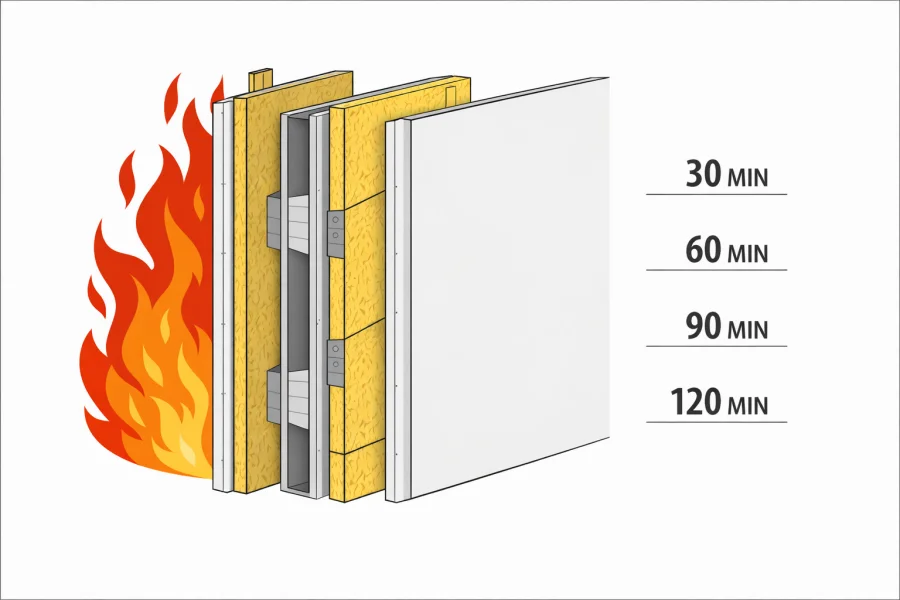
The Science Behind Fire Resistance Ratings: Understanding 30, 60, 120 & 240 Minutes Protection
Fire resistance ratings form the backbone of passive fire protection systems, serving as a measurable indicator of how long a building component can withstand fire exposure while maintaining its functional integrity. Commonly expressed in minutes such as 30, 60, 120, or 240 these ratings are not arbitrary figures but are derived from rigorous scientific testing and standardized evaluation methods.
At its core, a fire resistance rating represents the duration for which a structural element or assembly can resist the effects of fire under controlled conditions. These effects include heat transfer, structural degradation, and the passage of flames or gases. The goal is to ensure that buildings provide sufficient time for occupants to evacuate and for emergency responders to control the situation.
The science behind fire resistance ratings is rooted in three critical performance criteria: load-bearing capacity, integrity, and insulation—often referred to as R, E, and I. Load-bearing capacity (R) measures the ability of a structural element to support its load during fire exposure without collapsing. Integrity (E) ensures that flames and hot gases do not pass through the element, preventing fire spread. Insulation (I) limits the temperature rise on the unexposed side, reducing the risk of ignition of adjacent materials.
Fire resistance testing is conducted in specialized furnaces that simulate real fire conditions. These tests follow standardized time-temperature curves, such as those defined in international standards like ISO 834. The furnace temperature rises rapidly, reaching approximately 550°C within the first five minutes and exceeding 1000°C over time. Building elements are exposed to this intense heat while their performance is closely monitored.
A 30-minute fire rating typically applies to non-critical partitions or elements in low-risk areas. These systems provide basic protection and are often used in residential buildings or small offices. While they offer limited resistance, they can still play a crucial role in slowing down fire spread during the initial stages.
A 60-minute rating represents a moderate level of fire resistance and is commonly used in commercial buildings, corridors, and escape routes. At this level, materials and assemblies are designed to maintain their structural and thermal performance for a longer duration, ensuring safer evacuation.
For higher-risk environments, such as hospitals, high-rise buildings, and industrial facilities, 120-minute ratings are often required. These systems provide extended protection, allowing more time for evacuation and firefighting operations. Structural elements with this rating are typically reinforced with advanced fireproofing materials such as intumescent coatings or cementitious layers.
The highest commonly used rating, 240 minutes, is reserved for critical infrastructure, including data centers, oil and gas facilities, and high-value assets. These systems are designed to withstand prolonged fire exposure, ensuring minimal structural damage and maximum containment.
Material behavior under fire is a key factor influencing fire resistance ratings. Steel, for instance, loses its strength rapidly at high temperatures, making it vulnerable to collapse. To counter this, fireproofing materials are applied to insulate the steel and delay heat transfer. Concrete, on the other hand, has inherent fire resistance but can suffer from spalling when exposed to extreme heat, which must be addressed through proper design.
Fire-resistant glass, gypsum boards, and specialized insulation materials are also engineered to meet specific fire resistance criteria. Each material undergoes extensive testing to ensure compliance with standards and performance requirements.
From an Indian regulatory perspective, the National Building Code provides guidance on fire resistance ratings and area limitations. However, many large industrial projects adopt performance-based assessments to justify extended compartment sizes or alternative protection strategies. Given the economic importance of uninterrupted logistics operations, downtime resulting from fire incidents can be catastrophic. Therefore, passive fire protection must be integrated into business continuity planning.
Despite the scientific rigor behind fire resistance ratings, their effectiveness in real-world scenarios depends heavily on proper installation and maintenance. Gaps, poor workmanship, or the use of non-certified materials can compromise the entire system. For instance, an improperly sealed cable penetration can allow fire and smoke to bypass fire-rated barriers, rendering them ineffective.
Regulatory frameworks such as the National Building Code of India provide guidelines on fire resistance requirements for different building types. However, enforcement and awareness remain challenges. Many buildings fail to meet the required standards due to cost-cutting measures or lack of technical expertise.
Another important aspect is the integration of fire resistance ratings into overall building design. Architects and engineers must consider factors such as occupancy type, fire load, and evacuation strategies when selecting appropriate fire ratings. Overdesign can lead to unnecessary costs, while underdesign can pose serious safety risks.
Advancements in materials science are continuously improving fire resistance capabilities. Modern fireproofing solutions are lighter, more efficient, and environmentally friendly. These innovations are enabling the construction of safer buildings without compromising on design or sustainability.
In conclusion, fire resistance ratings are a critical component of passive fire protection, providing a scientific basis for designing fire-safe structures. By understanding the principles behind these ratings, stakeholders can make informed decisions that enhance safety, ensure compliance, and protect lives and property. As urban environments become more complex, the importance of accurate and reliable fire resistance ratings will only continue to grow.