Nano-Coatings in Passive Fire Safety: A Game Changer in Material Engineering
Passive Fire Protection (PFP) is undergoing a material science revolution, and at the heart of this transformation lies a cutting-edge innovation: nano-coatings. Traditionally, PFP systems have relied on bulky materials—intumescent paints, fire-rated boards, mineral wool, and cementitious sprays—to resist and contain fire. While these materials have proven effective, they come with limitations such as weight, thickness, degradation over time, and challenges in adhering to complex geometries. Enter nano-coatings—a futuristic approach that harnesses the power of nanotechnology to deliver superior fire resistance in a lighter, thinner, and more efficient form.
Nano-coatings are surface treatments developed using nanoparticles that operate at the scale of one-billionth of a meter. Their nano-sized particles allow them to form incredibly thin, uniform, and tightly bonded layers that modify the physical, chemical, and thermal properties of the surface they are applied to. In the context of passive fire protection, nano-coatings are engineered to provide excellent thermal insulation, flame retardancy, and in some cases, even self-healing capabilities under heat stress.
One of the key advantages of nano-coatings is their ability to be tailored for specific fire-resistance needs. Unlike traditional fireproofing materials that rely on bulk insulation or reactive expansion under heat, nano-coatings can be designed at the molecular level to include flame retardant additives, thermal barriers, and oxidation inhibitors all within a single ultra-thin layer. This level of customization means that they can be applied to a wide variety of substrates—including metals, plastics, wood, textiles, and composites—without compromising structural or aesthetic integrity.
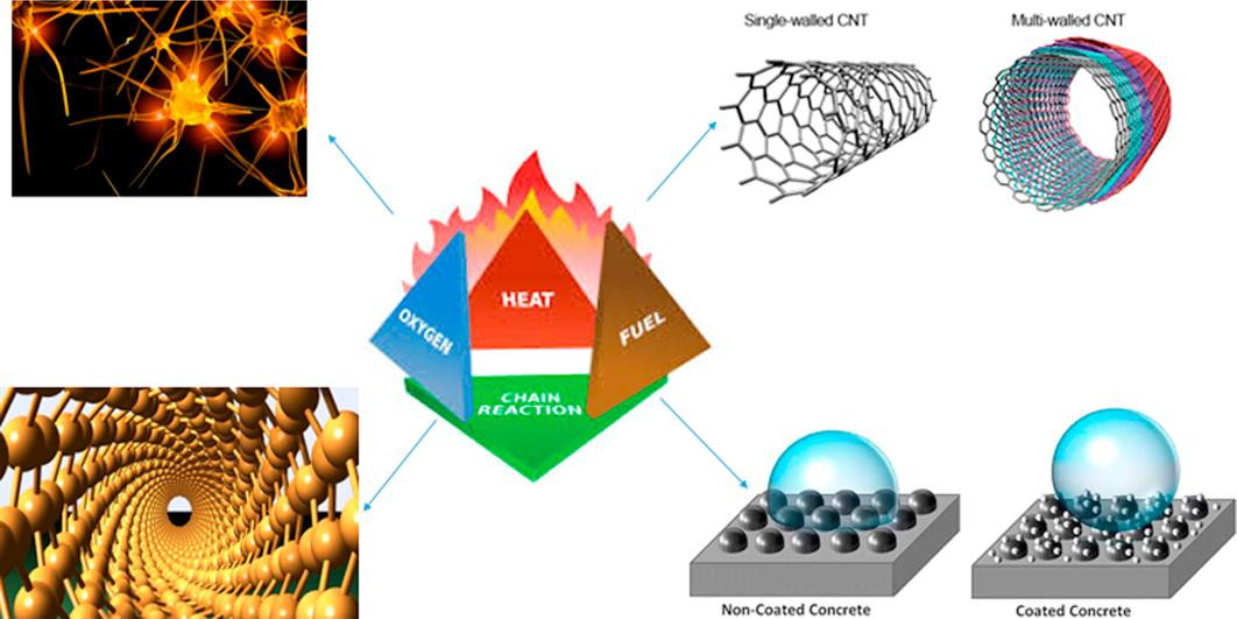
A common type of fire-resistant nano-coating includes silica-based nanoparticles. When exposed to heat, these coatings form a ceramic-like layer that resists thermal conductivity and slows down combustion. Other variations use carbon nanotubes or graphene, materials known for their exceptional strength and thermal stability. These materials create a high-performance barrier that limits oxygen access, delays heat transfer, and suppresses toxic smoke release, thus enhancing occupant safety during fire incidents.
Another fascinating innovation in nano-coatings is the development of intumescent nano-layers. Intumescent materials expand and form a charred, insulating layer when exposed to heat, which protects the underlying substrate. By integrating this property into a nano-scale coating, researchers have created fireproofing solutions that activate quickly and perform reliably without the need for thick application layers. This is particularly useful in industries like aerospace, automotive, and electronics where space, weight, and material performance are all critical.
The applications of nano-coatings in passive fire safety are growing rapidly across sectors. In the construction industry, they are being used to coat structural steel and concrete to enhance fire ratings without adding unnecessary weight or bulk. For heritage buildings, where preserving original materials is essential, nano-coatings offer a non-invasive method to upgrade fire safety while maintaining historical aesthetics. In mass transportation—rail, aviation, and shipping—nano-coatings are being adopted to protect interiors, wiring systems, and critical components, ensuring fire does not compromise safety during travel.
Electronics and data centers represent another area where nano-coatings are proving to be game-changers. As the demand for high-density server installations grows, so does the need for compact, fire-resistant solutions. Nano-coatings can be applied to circuit boards, battery units, and connectors to reduce fire risk caused by overheating, electrical faults, or short circuits. Their resistance to thermal degradation and ability to repel moisture and dust further enhances operational safety and longevity.
In India, where rapid urbanization, infrastructure development, and high-rise construction are increasing fire safety demands, nano-coatings offer an especially compelling proposition. High ambient temperatures, monsoon humidity, and construction dust can degrade traditional fireproofing systems over time. Nano-coatings, in contrast, exhibit excellent durability under environmental stress and require minimal maintenance. Their hydrophobic (water-repellent) and anti-corrosive properties make them ideal for Indian climatic conditions, especially in coastal and industrial zones.
The sustainability factor further boosts the appeal of nano-coatings in passive fire protection. Many modern nano-coatings are free of halogens, heavy metals, and volatile organic compounds (VOCs), making them environmentally safer than older fire retardants. Their long life cycles reduce the need for reapplication, lowering overall material consumption. Additionally, because they enable fireproofing at a micro level, less raw material is needed to achieve the same level of fire safety—reducing the environmental footprint of buildings and manufactured goods.
Despite their many advantages, challenges remain in the widespread adoption of nano-coatings. The technology is still relatively new and often comes at a premium cost. Additionally, standardized fire testing and certification protocols for nano-materials are still evolving, which can create regulatory hurdles. There is also a lack of awareness and technical know-how among building professionals, architects, and facility managers about the performance characteristics and application methods of nano-coatings.
However, with increasing research investments and pilot projects, the industry is gradually overcoming these barriers. Start-ups and research institutions are developing hybrid nano-coatings that combine fire resistance with other functionalities such as antimicrobial protection, UV resistance, and energy reflectivity. This multi-functionality is particularly attractive in modern smart buildings where integrated performance is a key goal. Some recent studies even point to the possibility of self-healing nano-coatings that can repair micro-cracks under heat exposure, thereby prolonging the life of fire barriers without human intervention.
Looking ahead, the future of passive fire safety may well rest on the nanoscopic scale. As nanotechnology continues to mature and regulatory frameworks catch up, nano-coatings will become increasingly mainstream in building codes and fire safety standards. Their adaptability, performance, and compatibility with smart material systems will make them an integral part of next-generation construction and manufacturing.
To realize their full potential, stakeholders across the fire safety ecosystem—manufacturers, developers, policy makers, and architects—must collaborate to fund research, build awareness, and incentivize adoption through green building certifications and fire safety incentives. Institutions like the Bureau of Indian Standards (BIS) and Fire and Security Association of India (FSAI) can play pivotal roles in drafting guidelines and performance benchmarks that accelerate the entry of nano-coatings into mainstream safety strategies.
In conclusion, nano-coatings represent a monumental leap in passive fire protection, offering intelligent, thin, and adaptable layers of defense that transcend the limitations of traditional fireproofing. By integrating nanotechnology into fire safety engineering, we are not only making buildings safer but also smarter, lighter, and more sustainable. In a world increasingly shaped by climate risks and urban density, innovations like nano-coatings are not just desirable—they are essential.