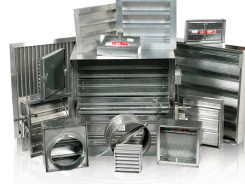
Fire safety in buildings is no longer limited to alarms, sprinklers, and extinguishers. Passive fire protection has emerged as a cornerstone of safety, ensuring that fire is contained and its spread delayed. Among the many components of passive fire systems, fire dampers play a critical role. Often hidden within heating, ventilation, and air-conditioning (HVAC) systems, fire dampers are silent guardians, ready to deploy when heat or flames threaten to travel through ducts and compromise fire compartments.
In high rise buildings, hospitals, malls, data centers, and airports, where central air systems circulate through multiple zones, fire dampers ensure that smoke and fire do not bypass barriers. Without them, a well-designed compartmentation plan can be rendered ineffective within minutes.
UUNDERSTANDING FIRE DAMPERS
A fire damper is a device installed in HVAC ducts designed to close automatically in the event of a fire. The damper prevents the spread of fire and smoke through ventilation pathways, maintaining the compartmentation of the building.
They work by detecting high heat or smoke conditions and sealing off the duct passage with blades or shutters. Once activated, they help contain the fire within its origin area, allowing occupants more time to evacuate and first responders to take control.
HOW FIRE DAMPERS WORK?
Fire dampers operate primarily through fusible links or thermal sensors:
- Fusible Link Dampers - Equipped with a metal link designed to melt at a specific temperature (commonly 72°C). When the link melts, the damper blades close.
- Motorized Fire Dampers - Powered by actuators, these dampers respond to smoke detectors or building fire alarm systems, ensuring more controlled closure.
- Combination Smoke and Fire Dampers - These not only block flames but also prevent smoke spread, a leading cause of fatalities during fires.
TYPES OF FIRE DAMPERS
Fire dampers come in several designs to suit building requirements:
- Curtain Fire Dampers : Multiple interlocking blades collapse like a curtain when released.
- Multi-Blade Dampers: Parallel blades rotate to close off the duct opening.
- Smoke Control Dampers : Specifically designed to manage smoke movement and pressurization systems.
- Combination Dampers: Offer both fire and smoke protection.
The choice depends on duct size, building use, airflow pressure, and local fire safety codes.
FIRE DAMPERS AND BUILDING CODES
Fire dampers are governed by international and national codes such as:
- NFPA 80 & NFPA 105 : Standards for fire doors, fire windows, dampers, and smoke dampers.
- UL 555 & UL 555S: Testing standards for fire dampers and smoke dampers.
- NBC (National Building Code of India): Recognizes fire dampers as a critical component of HVAC fire safety.
Compliance ensures that fire dampers are tested under conditions replicating real fire scenarios, giving assurance of performance.
IMPORTANCE IN HIGH- RISK BUILDINGS
Certain occupancies demand higher fire safety standards, making fire dampers indispensable:
- Hospitals: Fire dampers protect vulnerable patients in ICUs and wards where evacuation is challenging.
- Airports and Metro Stations: Where thousands pass through daily, dampers ensure smoke does not choke evacuation routes.
- Data Centers: Fire dampers safeguard IT infrastructure worth millions, preventing downtime and catastrophic data loss.
- High-Rise Residential Towers : With interconnected HVAC ducts, dampers prevent vertical smoke spread.
INSTALLATION AND MAINTANANCE CHALLENGES
While fire dampers are vital, their effectiveness depends on proper installation and upkeep. Common challenges include:
- Improper Alignment - Misaligned blades compromise sealing.
- Blocked Access Panels -Fire dampers must be easily accessible for inspection.
- Dust and Debris Accumulation- Prevents smooth closure.
- Lack of Regular Testing -Dampers must be tested at intervals to ensure readiness.
In India, one of the biggest gaps is maintenance. Fire dampers are often “install and forget” systems, with little inspection until an incident occurs. Regular audits and facility management awareness are key to bridging this gap.
TESTING AND PRACTICES
Industry best practices recommend:
- Visual Inspection at least once every six months.
- Operational Testing annually, simulating closure conditions.
- Documentationof every inspection, aligned with code requirements.
- Replacement of Fusible Linksduring each inspection cycle to ensure reliability.
Testing ensures that dampers will perform when needed, rather than failing silently.
INNOVATIONS IN FIRE DAMPERTECHNOLOGY
Modern developments are making fire dampers smarter and more reliable:
- Motorized Intelligent Dampers integrated with Building Management Systems (BMS).
- Low-Leakage Dampers for energy efficiency without compromising safety.
- Compact Design Dampers suitable for high-density duct layouts.
- IoT-Enabled Monitoring where dampers report operational status in real time.
These innovations align with the growing demand for smart and sustainable buildings.
CONCLUSION
Fire dampers are an unsung hero of passive fire safety. They ensure that HVAC systems designed for comfort do not become conduits of disaster during fire emergencies. In modern India, where urban infrastructure is expanding rapidly, integrating and maintaining fire dampers is not optional but mandatory.
They bridge the gap between passive and active fire safety, proving that even hidden systems can save lives when designed, installed, and maintained correctly.