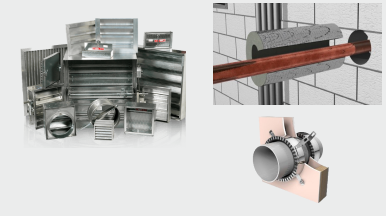
The Forgotten Heroes: Fire Dampers, Sleeves, And Collars In Building Design
In the vast and intricate world of building safety, many components attract visible attention—fire alarms, extinguishers, sprinklers, and emergency exits. However, tucked away in walls, ceilings, ducts, and shafts are the quiet protectors of a building's fire integrity: fire dampers, sleeves, and collars. These passive fire protection elements rarely make headlines or feature in glossy project brochures, but when a fire breaks out, they are often the reason lives are saved, fire is contained, and structural damage is minimized. Their role may be hidden, but their importance is monumental.
Modern buildings are complex systems of mechanical, electrical, and plumbing (MEP) services. These systems require openings through walls, floors, and ceilings—creating potential breaches in fire-rated compartments. Left unprotected, these gaps can become deadly conduits for smoke and flame. Fire dampers, sleeves, and collars are purpose-built to seal off these routes when fire strikes, preserving the integrity of fire barriers and maintaining critical compartmentation. They’re not decorative, but they’re indispensable.
FIRE DAMPERS: THE GATEKEEPERS OF HVAC SAFETY
Fire dampers are mechanical devices installed in heating, ventilation, and air conditioning (HVAC) ducts that pass through fire-rated walls or floors. Their main function is to block the duct in the event of a fire, preventing the spread of flame and smoke through the ventilation system. Typically, fire dampers are held open by a fusible link that melts when temperatures rise, causing the damper to snap shut. Some advanced models are motor-operated and connected to building fire alarm systems.
Despite their mechanical simplicity, fire dampers are vital in any building design. Ducts can act like superhighways for smoke and hot gases. Without dampers, a fire in one part of the building can rapidly compromise other areas, making evacuation difficult and firefighting more dangerous. Properly installed and maintained fire dampers ensure that fire-rated walls and floors truly remain barriers—even when penetrated by HVAC systems.
In India, the National Building Code (NBC) 2016 mandates the installation of fire dampers at appropriate locations, especially at duct penetrations of fire-rated partitions. Global standards like UL 555 and EN 1366-2 are also often referenced for product testing and performance criteria. Regular inspection and testing of fire dampers—often overlooked—are essential to ensure they function when needed. A jammed or rusted fire damper can be as dangerous as not having one at all.
FIRE SLEEVES:PASSIVE FIRE STOPS FOR PIPE PENETRATIONS
Another often-underappreciated component in passive fire protection is the fire sleeve. Fire sleeves are protective coverings used to seal penetrations where plastic pipes or cables pass through fire-rated walls or floors. In a fire event, plastic pipes can melt rapidly, creating gaping holes that compromise compartmentation. Fire sleeves are made from intumescent materials that expand under heat, filling the void left by the melting pipe and maintaining the fire barrier.
Fire sleeves are especially important in residential buildings, hospitals, data centers, and commercial spaces with extensive plumbing or electrical infrastructure. Their effectiveness depends not just on the quality of the sleeve but also on the accuracy of its installation. The size of the pipe, the diameter of the penetration, the sleeve material, and the fire rating of the wall or floor all determine the appropriate sleeve to be used.
International standards such as EN 1366-3 and ASTM E814 guide the testing and application of fire stopping systems, including sleeves. In India, though BIS standards are evolving, many consultants specify products with international certifications (UL, FM Approved, CE Marked) to ensure compliance and performance.
FIRE COLLARS: THE LAST LINE OF DEFENCE
Closely related to fire sleeves, fire collars are another crucial part of passive fire protection. These are installed around plastic pipes at the point where they pass through fire-rated partitions. Like sleeves, fire collars contain intumescent materials that expand when exposed to high temperatures. As the pipe melts, the collar expands inward to close off the opening, effectively stopping the passage of smoke and flame.
Where fire collars differ is in their mechanical structure and use for larger or vertical installations. For example, collars are typically used on drainage or waste pipes that run vertically through floors. In multi-storey buildings, these vertical shafts can become disastrous channels during a fire. A properly installed fire collar ensures that the integrity of the floor slab is maintained, even if the pipe fails.
Fire collars must be tested and certified for specific applications. Using a collar that hasn’t been tested for the right pipe size, material, or wall/floor thickness can render it useless. Hence, manufacturers often provide detailed installation guidelines and fire test reports (commonly called “assessment reports”), which must be strictly followed.
INTEGRATION INTO BUILDING DESIGN AND CONSTRUCTION
Despite their importance, fire dampers, sleeves, and collars are frequently left out of early-stage architectural planning. Many times, these components are treated as afterthoughts—added hastily just before final inspection. This can lead to improper installation, mismatched materials, and significant safety gaps.
The key to success lies in integration. Architects, fire consultants, MEP designers, and contractors must work together from the design phase to ensure that every duct, pipe, or cable tray passing through a fire-rated partition has the appropriate passive fire protection component.
Building Information Modelling (BIM) tools can greatly aid this coordination by flagging penetrations and allowing accurate fire-stopping details to be embedded in construction documents. Additionally, fire audits and third-party inspections should focus not just on active systems but also on the passive components—many of which lie hidden behind false ceilings or wall cavities.
CHALLENGES AND THE WAY FORWARD
One of the biggest challenges in the Indian construction industry is awareness. Many builders, especially in cost-sensitive projects, tend to substitute certified fire collars and dampers with cheaper, non-compliant versions. This not only violates code but puts lives at risk. Another issue is improper installation—fire collars fixed upside-down, sleeves that don’t match pipe diameters, or dampers blocked by insulation are common findings during site inspections.
The solution lies in training, enforcement, and awareness. Authorities having jurisdiction (AHJs), such as fire departments and municipal bodies, need to mandate and inspect passive fire protection systems as rigorously as they do fire alarms and hydrants. Industry bodies must conduct training programs for contractors and installers. And architects and consultants must insist on tested and certified products, regardless of the project scale.
CONCLUSION
Fire dampers, sleeves, and collars may not have blinking lights or blaring sirens, but they are silent warriors in the fight against fire. These passive components ensure that the invisible boundaries designed to compartmentalize a building actually work when it matters most. They buy time, protect assets, and save lives—making them nothing short of heroes.
As we aim for safer, smarter, and more resilient buildings, let’s give these “forgotten heroes” the attention and respect they deserve. After all, the true measure of a fire-safe building lies not just in its ability to detect and fight flames, but in its capacity to contain and outlast them.